In 2025 South Dakota State University's department of agricultural and biological systems engineering celebrated a centennial, marking 100 years of progress and service to the state and beyond.
Joseph Schumacher, retired research engineer at SDSU, offers the following highlights on the department's role in advancing precision agriculture.
Curious about the early development of technology created to implement and support precision farming concepts and practices? If you are, then this historical poster should be of interest.
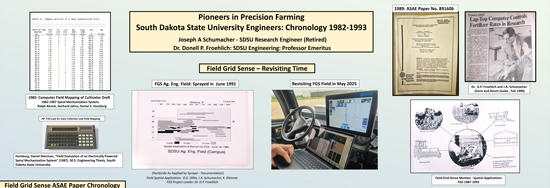
Additionally, a second historical poster on Precision Farming Technology Research by South Dakota State University Engineers (1982-1993) was presented at the 2025 ASABE Annual International Meeting, in Toronto, Canada. ASAE Conference Papers on “Spatial Field Control and Mapping” are highlighted in the poster.
Brought to Life: Evolution of Technology Applied to Spatial Field Variability and Spatial Control of Operations
1982–1987: Field Automation through an Electrically Powered Spiral Mechanization System
Dr. Ralph Alcock’s 1982 paper (ASAE NCR No. 82-0113) presented an adaptation of a Spiral Cable System developed and patented in the 1940’s by Frank W. Andrew for field automation. Dr. Alcock’s version used a center pivot irrigation system and was powered by electricity. Dr. Gerhard Jahns teamed up with Dr. Alcock to further advance the electrically powered Spiral System in 1983-84. Daniel Humburg then joined the team and performed a detailed field evaluation of the Spiral System. While performing this evaluation, D.S. Humburg used an HP-71B microcomputer system to collect real-time field operation data. Resulting in digital field mapping of variables such as cultivator draft measurement.
1987–1990: Field Grid Sense (FGS)—Real-time Interactive Mapping and Control in the Tractor Cab
Dr. Donell Froehlich in the spring of 1987 presented a HP-71B microcomputer to Joseph Schumacher, a graduate student ,and suggested applying its use to tractor operation. Joe was later sent to video tape Dr. Dwayne Beck’s recently designed No-Till Drill in operation at the Redfield experiment station. From the operation of the No-Till Drill, and the incorporation of controlled traffic lanes, was born the idea of Field Grid Sense and use of a laptop tractor-monitor for interactive mapping and equipment control. During ASAE meetings in 1990, Dr. John Schueller approached and expressed that our 1989 ASAE paper (No. 891606), presented previously, at the ASAE winter meeting, was receiving exceptional widespread recognition for a conference paper. The paper was presented by Joseph Schumacher. The Field Grid Sense project filled a 1989 technology void in “farm-based” precision agriculture.
The primary goal of Field Grid Sense was to create a tractor monitor (laptop computer) with GIS mapping and control capabilities that could be used at the local farm level. In turn, FGS became a catalysis, pioneering computerized precision farming via the field tractor. FGS’s monitor was more than a niche idea, as subsequent precision field monitors mirrored its format. The Field Grid Sense project provided a foothold for moving precision agriculture technology toward farmer-operated usage in agricultural field tasks.
1990–1993: FGS projects focused on field spraying, yield monitoring, terrain-vehicle attribute collection, and DGPS System incorporation. A large 1993 field study incorporating DGPS was conducted.
Project Engineers: Daniel Humburg, Joseph Schumacher, Dave Ollila, Kent Klemme
Project Leaders: Dr. Donell Froehlich, Dr. Ralph Alcock
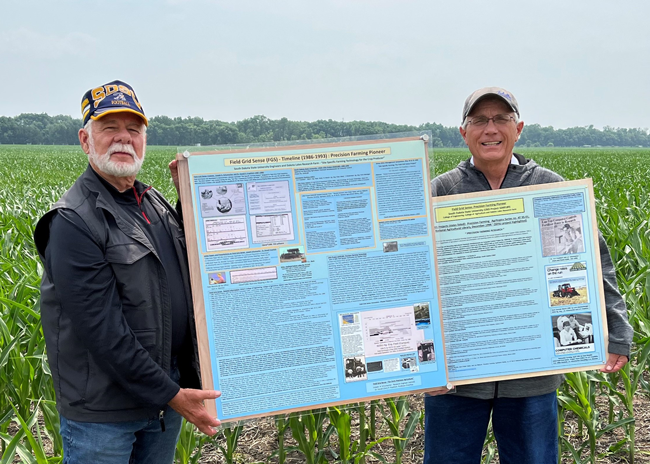
Donell P. Froehlich and Joseph A. Schumacher display Field Grid Sense posters developed for the South Dakota State University–Dakota Lakes Research Farm.